Thursday, July 21, 2022

Review of The Jonah Kit by Ian Watson

"Doing something new" or "Doing something different" is one of the most subjective aspects of science fiction, and literature in general. And never more so as we find ourselves a century-deep into mass publishing—literally millions of unique titles on the market. Going even deeper, the idea of "new and different" in American science fiction has largely been tied to technology, gadgets, sense of wonder, and the like. For European SF, new and different has more often been a product of style, technique, and fresh views to society, individuals, technology, and the human condition. Fightin' words if ever there were, the point I'm getting at is, if you're looking for something new and different in the latter vein, try Ian Watson's second novel, The Jonah Kit (1975).

A product of its times, the story of The Jonah Kit plays off the Cold War and the extremes of Soviet military research. Combine that with groundbreaking astronomy and visionary ichthyology, and the resulting tale bounces around a fair bit before making its connections known and drawing them together.

Sunday, July 17, 2022

Review of The Palace of Love by Jack Vance

While the Demon Prince pentalogy was published over a couple of decades, the first three volumes were written in very short succession. The result is a strong consistency of style and length in those first three novels; Vance was in the groove and pushed out the stories in short order. Let's take a look at the last of these three before the pause button on the series was pushed, The Palace of Love (1967).

With two princes down and dusted, Kirth Gersen looks to the next name on his Count-of-Monte-Cristo hit list—and perhaps the best named villain in the series, Viole Falushe. Where Kokor Hekkus' vices were rampant with unadulterated violence and madness, Falushe's evils are authoritarian. Maintaining a massive harem of unwilling women, he uses perfumes and poisons to rule a vast domain. That is, until Kirth Gersen steps into the picture to exact his revenge.

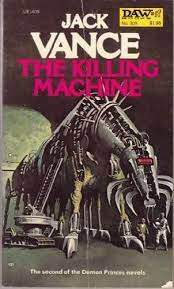
Review of The Killing Machine by Jack Vance

It is a maxim of storytelling that if you show a gun at the beginning of a story, at some time it will be fired. In Jack Vance's The Killing Machine (1964), second book in the Demon Prince series, the gun has metal mandibles, fire-breathing eyes, a segmented body, and mechanized centipede legs. With such extravagance, undoubtedly readers will be happy it fires, but perhaps less happy only once.

With Kirth Gersen's raison d'etre established in The Star King, The Killing Machine sees the second demon prince on the hit list, Kokor Hekkus fall under his crosshairs. More overtly evil than the Star King, Hekkus quickly shows Gersen how little existence means to him in an early, down-and-dirty encounter. Gersen manages to escape with his life, but also with a set of plans which seem to show the impossible: a highly unorthodox machine whose purpose could only be one thing, killing. But where, and why?

Sauron's Eye vs Cosmic Evil: Comparing The Lord of the Rings: The Card Game to Arkham Horror: The Card Game

When looking to get into the cooperative LCG scene, I spent a little bit of time searching online for comparisons of the Lord of the Rings and Arkham Horror card games (LCGs). The reason it was little time is because not a lot of content was available. A couple years later, there is still not a lot available. Older commentary exists—when Arkham was one or two campaigns old but LotR was quite established, the comparison not really 100% even. There is some personal opinion floating around—this game is better than that because I like ____, etc., etc. But since Arkham’s establishment (seven campaigns and counting), nothing really meaty has appeared online that compares and contrasts the two games with potential players in mind. I hope this is it.  (I've since all created a post comparing these two games with the third FFG cooperative card game, Marvel Champions.)

Looking ahead, I will be avoiding spoilers. The goal is to capture the key differences, locate common ground, and highlight what might be appealing to different types of board gamers. I am human, and therefore everything here is subject to opinion, but I hope that you will not find a more objective comparison online.


Similarities

There are several obvious similarities between Arkham and LotR. Both are cooperative card games for 1-4 players that play out in established IPs, Lovecraft and Tolkien’s worlds, respectively. Both are scenario driven games which ask players to build decks of cards they think will allow their characters the greatest chance of success at resolving the objectives of the given scenarios. And lastly, both games feature a similar flow; the characters are given a chance to acquire/spend resources to deploy their tools and allies in an attempt to defeat monsters and accomplish objectives, and after, the scenario fights back through threats and monsters in an attempt to defeat the heroes. There are several other minor similarities (business model, no two scenarios alike, etc.), but as a whole, each game sits within such parameters. It's the details which separate the games in which most interest can be found.

Wednesday, July 13, 2022

Review of The Forgotten Beasts of Eld by Patricia McKillip

I have previously tried and failed to read a Patricia McKillip novel, The Riddle Master of Hed. Perhaps it was just my mood, the wind in the trees, or position of the moon, but for whatever reason, my mind kept wandering, and every time it snapped back, it encountered vanilla this and vanilla that and eventually wandered away again. I put it down, perhaps for another day (or moon). Based on the accumulated weight of recommendation from trusted sources (and non-trusted), I picked up The Forgotten Beasts of Eld (1974). An excellent thing there are second chances.

The Forgotten Beasts of Eld is the story of Sybel, a teenage girl who lives alone on a mountain surrounded by animals and creatures she communicates with telepathically while studying magic. One day a man arrives at her house named Coren. He delivers a small boy, Tamlorn, whom he requests Sybel to care for. And for the next decade, Sybel does as much, becoming Tamlorn's mother in essence and spirit. It's thus when the boy's true identity is revealed and people come looking for him that Sybel's future comes under a different light. Everything she has learned about magic needed in the aftermath of these events, Sybel and her menagerie are forced into a role in the kingdom of Eld beyond her mountain, but one that may have more advantages in the long term, no matter how hard it is today.

Saturday, July 9, 2022

Review of Kowloon Tong by Paul Theroux

In my 20s and 30s, as I traveled to different places in the world, a minor inspiration was Paul Theroux. I read his slapdash travelogues with an eye to the experiences he had—China, Australia, and other such places. But as with a lot of travel writing of such length, Theroux inevitably reverted to dialogue and embellishment—a style which enhances readability but likewise creates degrees of doubt regarding the actuality of his journeys. It wasn't until later I started reading Theroux's fiction. And what I find is a more confident voice, one more subtly lays bare the psyches of its main characters. The latest peeled mind I discovered is Kowloon Tong (1997).

Kowloon Tong is a few months in the life of Neville (aka Bunt) Mullard. The son of a textile factory owner in Hong Kong, he inherits the business after his father passes away. Though in his forties, Muller is still a child in many ways. Unmarried, he lives with, and obeys, his mother. His life is as routine as can be, seeking pleasures without responsibilities in this city's “chicken houses”, daily following a schedule like a schoolboy. But change is looming. After 100 years, Britain is about to give up control of Hong Kong and hand the peninsula back to Chinese. Existentially stuck in the middle between China and England, Mullard finds himself facing uncomfortable but necessary decisions as the handover draws nigh.

Console Corner: Review of All Frostpunk DLC Expansions

This review is dedicated to the DLC expansions for Frostpunk as of the writing of this review.  To be clear, this post regards the video game, not the board game.  The six expansions are as follows:

The Arks

The Refugees

The Fall of Winterhome

The New Autumn

On the Edge

Endless Mode


The Arks”

The premise of “The Arks” is to use engineers to protect (i.e. keep warm) four buildings which house the seedlings that will be used to re-start agriculture once the deep freeze is over. But the scenario quickly evolves into: how well can the player manage multiple automatons to stockpile resources. The engineer (not worker) count is extremely limited, meaning players need to juggle automatons while developing the production base. This is one of the weakest DLCs for Frostpunk. While the starting conditions are different from the base scenario, the course of events almost entirely parallels “A New Home”, right down to a large, final storm. I can see people who did not use automatons in the main campaign getting the most out of this expansion. Other players will likely find the other expansions offer more unique challenges.

Wednesday, July 6, 2022

Review of The Alchemy of Stone by Ekaterina Sedia

Steampunk, oh steampunk, you oasis in the desert, calling me with your dreamy green palms and promise of refreshment. The adventure, the tropes, the potential—calling me across the blowing sands. This is good, and that is good, and this is good too—luring my parched throat and burning skin forward. And arrival... was it all a mirage? Let's take a look at The Alchemy of Stone by Ekaterina Sedia (2008).

The Alchemy of Stone is the story of Mattie. An automaton, she lives—ahem, exists—in a Victorian-esque city ruled by the Merchants and Alchemists, each of whom have their agendas regarding the creative direction the city should go. One of the most intelligent automatons ever created, Mattie has a love-hate relationship with her Mechanist creator, Loharri. When she requests to study as an Alchemist, he begrudgingly allows her but retains control of the key needed to keep her heart wound, and in essence her body alive. But Mattie's situation becomes more complicated when she is secretly contacted by a group of gargoyles—immobile stone creatures who wish to become mobile and escape the city—against the wishes of both the Mechanists and Alchemists. Empathizing with the gargoyles and their non-flesh existence, Mattie embarks on a mission to find the alchemy which will convert stone to flesh.

Cardboard Corner: Ranking Arkham Horror: The Card Game Final Scenarios/Bosses

One of the best parts of video games is 'the final boss'. A true test of the skills you've learned, it's usually an over-the-top experience that feels great when you finally squeak past. Smartly, Arkham Horror: The Card Game has taken the nod and implemented a final boss in all of its campaigns released to date—sometimes more than one. Let's see how they rank.

Three important things before moving ahead:

  1. Warning-Warning-Warning: this article assumes you've played all the campaigns, so if you don't want any final scenario spoiled, wait to read.

  2. With the exception of perhaps “The Devourer Below”, there is not a bad final scenario in the game. Whatever scenarios end up low in the ranking are still a huge amount of fun.

  3. This is a live page. I will update it as campaigns are released and played.

Jumping right into things, from lowest to highest ranked, here is the list:

Saturday, July 2, 2022

Review of Age of Ash by Daniel Abraham

Daniel Abraham is one of the busiest men in writing. He is one half of the “James S.A. Corey” pen name which produces the Expanse series (ten books and counting), as well as co-writer on the television adaptation. He is the writer behind the pen name M.L.N. Hanover, and adapts George R.R. Martin's A Song of Ice and Fire books into graphic novel form. He regularly contributes short stories to Martin's Wild Cards anthology series and other venues. On top of all this, he somehow finds time to write epic fantasy under his own name, producing two lengthy series the past 15 years, The Long Price quartet and The Dagger & Coin series. The latest fantasy series to come out kicks off with Age of Ash (2022). Let's see if the workload affects quality.

Age of Ash, while occasionally viewed through side characters, is predominantly experienced through the eyes of Alys and Sammis. Alys is tough and street smart. Part of a gang of petty thieves, she runs distractions while her accomplices, one of whom is her brother Darro, get away with people's valuables in crowded markets and streets. Darro has loftier goals in life, but his schemes eventually catch up to him, leaving Alys with even tougher choices to make. Sammis is the ying to Alys' feisty yang. Quieter, calmer, she takes lesser known paths to resolve problems—particularly the problems Darro's adventures get the gang into.