Friday, January 20, 2023

Review of Tomorrow's Parties: Life in the Anthropocene ed. by Jonathan Strahan

With weather patterns visibly evolving in my lifetime, global warming seems a real thing. There are clearly biodiversity issues occurring due to humanity, i.e. the expedited extinction of species, but as for the concept of global warming as a whole, science has yet to write the definitive chapter. Is it natural, or are we, the most advanced monkeys on Earth, to blame? There is a significant chunk of people who say 'yes' to the latter, and have dubbed the era the anthropocene. Regardless one's opinions or views, Tomorrow's Parties: Life in the Anthropocene (2022), edited by Jonathan Strahan, features a suite of short stories looking at the concept from a variety of interesting perspectives.

The anthology, however, does not kick off on a bang. “Drone Pirates of Silicon Valley” by Meg Elison is a YA story that postulates: what if Robin Hood stole from everybody, not just the rich. It features a group of teens who start start capturing Amazon-esque delivery drones and redistributing their contents—at least those they don’t want. A “corporations are evil” story, it blurs the line between legal and illegal in ideological rather than realistic fashion with weakly characterized people. A might makes right sketch, the story would have been better off at longer length to flesh out the characters and implications of their piracy. Another story that could have been novella but in this case has enough meat on the bone to be a short, “Down and Out in Exile Park” by Tade Thompson takes the tons and tons of plastic in the ocean to its logical conclusion and posits a floating island named Exile. Exile so big as to become inhabited, Thompson locates a socio-anarchic society of Nigerian political deviants on the “land”, then sets them spinning with a most delightfully bizarre idea regarding their “religion”. Thompson has received increasing accolades in the past five years, and the story shows him growing in strength.

Monday, January 16, 2023

Review of Tangents by Greg Bear

Science fiction in the late 70s and through the 80s was a semi-confused time. Post-New Wave, writers and readers were trying to find a new direction—a difficult thing considering the major nodes in the genre sphere had already been mapped. And while writers like William Gibson and Bruce Sterling established cyberpunk (perhaps more a motif than sub-genre), most other authors fell back on what had been successful prior to New Wave. Writers like David Brin, Gregory Benford, Kim Stanley Robinson, James Patrick Kelly, and Lois McMaster Bujold came to the forefront writing tried and true tales but with up to date knowledge and modern sentiment. Their concepts extrapolated on scientific revelations, prose was more straight-forward than experimental, and characters received the same attention as the -isms. Greg Bear was also a central figure, and as a result his 1989 collection Tangents provides a mini-cross section of the 80s.

The novelette that spawned the novel, “Blood Music” kicks off Tangents. It tells of nanotechnology gone wild, and while an interesting idea, execution leaves something to be desired given how easily it descends into hand-waving mediocrity. To be fair, the novelization is poorer. Something of a ghost story bildungsroman, in “Sleepside Story” a young man from a poor, broken family finds himself being asked to pay the debts of his mother's Dayside debts at an ethereal bordello on Sleepside. Better scene setting would have drawn more mood from this story, and more mood is what it needed, as it stands as a failry straight-forward ghost story.

Cardboard Corner: Review of Tash-Kalar: Arena of Legends

There have been various times in my life when the stars held interest. Getting out a map, I would gaze into the heavens, trying to find this constellation or that. Formlessness converted to form, where the stars at first seem scattered, a deeper look can convert them into shapes—lions, crabs, wagons, crosses, and dippers. 2013’s Tash Kalar: Arena of Legends takes this idea and converts it into a board game.

In Tash Kalar, 2-4 players (best at 2) take on the role of dueling wizards. Representing one of the four factions available, players play cards with “constellations” (patterns) on them. These constellations come in the shape of fantastical beasts, warriors, nymphs, bears, and all other manner of battle-hardened creatures. Players summon creatures shown on their cards by placing tokens on the game board matching the pattern. Their goal is to disrupt their opponent's patterns and/or put tokens to score objective points, depending which game mode players choose (more in a moment). A back and forth abstract battle, players look to deploy ever more powerful creatures (i.e. more complex patterns), from common to heroic to legendary, to become the winner.

Friday, January 13, 2023

Review of Talking Man by Terry Bisson

For people who regularly read, undoubtedly you have that writer who, upon completion of one of their books or stories, you say to yourself: Why am I not reading more by them?!?! I also have a few such authors, of which Terry Bisson is one. Attempting to remedy regret, I jumped into Talking Man (1986).

Backcover copy for Talking Man is likely not to induce interest. A book that needs to be experienced, boiling it down to its component parts is like boiling a human down to a skeleton; you can tell something about it, but it's flesh and blood that give it character. So, I could say Talking Man is: a surrealist teenage '60s road trip chasing down a supernatural engine mechanic from the Kentucky foothills who has had a numinous glass owl stolen from him. But that might just register as odd, no? It is, however, the skeleton.

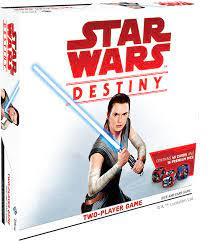
Cardboard Corner: Review of Star Wars: Destiny

I am one of thousands of people who are sucked into expendable card games, many of which are produced by Fantasy Flight Games (FFG). The customization, the imaginative worlds, and the pedigree (art, QA, first principles, etc.) have my grey matter in a tight, warm grip. And so, despite the fact I have four competitive expandable games already sitting on my shelf, I was curious when seeing that FFG had released another. What's the wrinkle, and can FFG continue the success?

Destiny is a two-player collectible card game set in the Star Wars universe that works according to the same general principles as other tabletop card games like Magic: The Gathering, Pokémon, etc. Players construct decks of cards to battle each other head-to-head. In Destiny, players start with hero/villain characters already on the table, ready to go—Luke Skywalker, Darth Vader, Obi Wan Kenobi, and a million more. They then draw hands of cards, which can include Support cards that bolster characters (vehicles, droids, etc.), Event cards that provide one time benefits, and Upgrade cards that can be attached to specific heroes/villains to provide bonuses. Reduce your opponent's hit points to zero, and you win. This is all pretty standard stuff.

Wednesday, January 11, 2023

Review of Deadman's Road by Joe R. Lansdale

Pulp fiction is one of the most challenging areas of the reading experience. Capable of being rendered in the most purple of prose with the cheapest, most embarrassingly shallow of conceptions, it's no surprise that a large chunk of people turn their noses up at it. At the same time, when written with attention to the fundamentals of storytelling and technique, it can be a relaxing escape from reality—a sugar cube melting in the brain. It increases the chance for cavities if consumed in quantity, sure, but if brushed with proper literary material can be worth the pleasure. One such sugar cube is Joe R. Lansdale's collection Deadman's Road (2010). Homage to Weird West of yesteryear incoming.

Published between 1896 and 2010, the stories collected in Deadman's Road are individual but bound together by the anti-hero, Reverend Jedidiah Mercer. Van Helsing, Solomon Kane, Jonah Hex, and a host of other dark pulp heroes his contemporaries, Mercer lives by the gun, bible, and whiskey. His character wholly gray, Mercer possesses a sharp tongue, short temper, and an irascible lack of patience in delivering hard justice to the creatures and peoples of the world, all in the name of God. Without his character, the stories wouldn't be half of what they are. And for the concerned, it's clear there is no underlying religious message; the Rev's hardline beliefs are just color for character. Zombies outnumber Bible quotes 100 to 1.

Cardboard Corner: Review of Sonar

Battleship is one of the most iconic board games of all time, and one which I owned as a child. And I still remember my methodical approach to the game. Marching up and down the columns, I would systematically find and destroy my opponent’s ships, winning and losing based on the other player's luck. Game play very straight-forward, Battleship cannot be played repetitively without some variations (beyond the expectations of a nine year old boy, of course). Sonar (2017) takes Battleship to the next… sea? wave? rank? I guess ‘level’ is still the best metaphor…

In Sonar, two teams (2 players each) pilot submarines through the deep dark, trying to blast their opponents’ sub to smithereens, doing their best to avoid the same fate. One player is the captain; they move the submarine, decide when to surface, decide when to go silent, and ask the other team for grid coordinates. The second player is the radio operator; they listen to the other submarine’s movements and map them on the grid board, trying to guess where they are, and inform the captain where might be a good shot. A physical barrier separating the two teams, captain and radio operator are forced to do things by sound and feel. Score two hits on your opponent, your teams. Get hit twice, you lose.

Sunday, January 8, 2023

Review of The Sorcerer of Pyongyang by Marcel Theroux

While Russia is currently doing its best, unfortunately, to take the mantle of World's Shittiest Regime, the global consensus is that North Korea is the current title holder. Reality all too harsh for the majority of its population and all too egotistical for the extreme minority in power, the stories coming out of the Asian country are often heartbreaking. Poverty, food shortages, illness, tyranny, oppression, nuclear saber-rattling—this list of things remains part of everyday existence for most North Koreans. No secret either, the country's conditions are well-known to anyone who pays even the slightest attention to news. What then could be the hook of a novel about a young man raised in North Korea? In such conditions, the potential reader is thinking: Here we go, a feel-really-good or feel-really-bad story about a victim of North Korea. What could Marcel Theroux have to offer the reader in The Sorcerer of Pyongyang (2022)? Don't make the mistake of assuming black or white. The novel is color—of the hounds of hell, wizard spells, and gleaming treasure variety.

The Sorcerer of Pyongyang begins in the nineties in the childhood of a boy named Cho Jun-su. Jun-su's father works in one of the only hotels catering to foreign tourists, and one day becomes the unwitting owner of a Dungeons & Dragons manual that a guest accidentally left behind. Thinking nothing of it, he gives the manual to his son, Jun-su. While Jun-su initially dismisses the exotic images of demons and wizards as capitalist propaganda, through a chance encounter he takes part in a mini D&D campaign. And his mind is blown. The role-playing game allows him to imagine a whole other world. Growing older, Jun-su takes the manual with him. As a university student, he makes friends and builds a group of D&D players. And with the evolution of North Korea and change of dictators pushing him forward (and sometimes under), Jun-su rides the wave to an existence no reader can predict.

Thursday, January 5, 2023

Best Reads of 2022

The following are Speculiction's best books read in 2022, regardless of year published. (For the list of books published exclusively in 2022, see here.) Without further ado, here are the eleven books:


Stamping Butterflies by Jon Courtenay Grimwood – Inception-esque, Stamping Butterflies wraps a story of far-future Chinese rule in the story of a would-be terrorist assassin circa 2000 in the story of a Marrrakeshi street urchin in the 70s. One feeding the other feeding the other, Grimwood provides the reader a visual feast in the future, a puzzle in the present (at least the book's 2000 present), and a human story in the past that comments on the West's involvement in the Middle East of the 70s. I'm not sure which of the author's novels is his masterpiece, but there is an argument for this one.

The Stuff Our Dreams Is Made Of: How Science Fiction Conquered the World by Thomas Disch – The only piece of non-fiction on this list, Disch makes a strong impression on the origins and evolution of science fiction through strong prose and strong opinion. Challenging a fair number of dominant meta-narrative regarding science fiction, the book comes highly recommended to readers familiar and interested in the science fiction at the social and cultural level. While published in 1998, and thus lacking a couple decades of the genre since, it remains prescient regarding the cultuure wars and identity politics that threaten to take over today.

Monday, January 2, 2023

Speculiction's Best Fiction Published in 2022

It is the end of 2022, and time to look back at the fiction published in the year. War has come to Ukraine, unfortunately, but the market today shows only minimal signs of slowing. I imagine as we get into a recession next year we will see the impact, likely a reduction in the number of books published. Wokeness continues to stamp like a buffalo through Western life and speculative fiction, but there are signs it has reached its peak. This mainly comes in the form of ubiquity; if one sees its signals everywhere, it means the movement has shifted from sub-culture to culture, and the only place to go from there is the past—like the mullet. The recession hopefully (should?) also do its part to refocus readers and publishers on reality.  I suspect we will still see the woke content which is in production today released next year, but as the year goes on it should drop off as publishers today realize it just doesn't sell on the mass market. 

But I ramble about the future.  As to 2022, I read a number of recommendable books. My gut gives the year the highly official title of: better than average. But before getting to the blue ribbons, some honorable mentions. 

The ever-unpredictable Adam Roberts provided readers the mini tongue twister The This. It addresses society in a world where the thumbs are replaced by the brain as the main technological channel of commenting and communicating in social tech. With a bizarre alien war in the far future plopping in to shake things up the book does not give the appearance of being sophisticated, but look a level deeper and the social media ills of our age, predominantly loneliness, ring like a bell. Oliver Langmead's Glitterati, while incomplete in places, nevertheless deserves mention for being so damn unique—an almost impossible task in 2022 given the century+ of publishing and thousands upon thousands of speculative fiction books available. Not dependent on a gimmick, Langmead pilots a straightforward dystopia yet with atypical captain and crew. Fashionistas ruling the unfashionable, Langmead puts a trendsetter front and center, then puts him through the most oblique Ru Paul grinder the reader could imagine. Plot transitions are a bit patchy at times, but the touch and feel of this novel are unlike anything you've read. Marcel Theroux's The Sorcerer of Pyongyang may be the most accomplished novel I read in 2022. A character study of a boy raised in '90s North Korea, the discovery of a Dungeons & Dragons manual changes his life's course. Not a nerd's paradise of demons and wizards, Theroux instead uses the role-playing game as a counter-point to the fantasy of the North Korean regime, in turning telling an affecting, tragi-comic story that keeps the reader glued to the page with smooth, precise prose. This book will likely fly under a lot of people's radars, so if the premise sounds interesting, give it a chance.