Wednesday, July 31, 2024

Review of Cryptozoic by Brian Aldiss

With great quantity comes great chances of a stinker. With Brian Aldiss, and his dozens of novels and one-hundred+ short stories, it was just a matter of time. <DING> It's Cryptozoic (1967). A kitchen sink of fiction, the novel changes identity more times than a Gen Z teen from an ultra-liberal family, making for a difficult piece of fiction to make heads or tails of (mixed metaphors intentional, natch).

Cryptozoic is the story of Bush, an artist living circa 2090. But at the start of the novel he is deep in mind travel in the Jurassic past. Mind travel a form of time travel, it allows people to cast their consciousness deep into the depths of time. Physical contact not possible, people can nevertheless go back and observe, and if they happen to meet other minds, interact. People spend years embedded in mind travel, it's thus happens that Bush has a Rip van Winkle meets George Orwell moment when he awakes. And it's not good.

Monday, July 29, 2024

Review of Heralds of the Siege ed. by Nick Kyme and Laurie Goulding

With the Black Library's decision to make Horus' attack on the solar system a separate series, the final books of the Horus Heresy end up reading more like bridge books. They connect what has happened previously and set the stage for the big conclusion, the Siege of Terra. Containing the precise moment Horus breaches the solar system, Heralds of the Siege (2018), an anthology edited by Nick Kyme and Laurie Goulding, gets the reader ready for the grand finale.

The anthology kicks off with one of the best in the bunch, “Dark Compliance” by John French. A frame story, it tells of Horus' general Argonis ordering a planet to bend the knee. When the planet's leader refuses, Argonis proceeds to tell the story of the last time a planet failed to capitulate. Giving the planet's leader a taste of things to come, it is dark compliance, indeed. While overall a straightforward story, the frame gives the story appreciable nuance. Another John French piece, “Now Peals Midnight” is more symbol than story. It exists to portray one moment, and for that I wish it had been located at the end of the anthology, but so be it.

Friday, July 26, 2024

Review of Electric Forest by Tanith Lee

There is a never a clear fault line between eras of fiction. Books appear here and there, under the radar, with one or two elements in common. Slowly these elements occur more often until coalescing into something identifiable, and at that point become a recognizable phenomenon in fiction. It's at this time that writers begin consciously producing material in and around the phenomenon. Then comes the inevitable exhausted—steampunk <cough-cough>. But we are not here for that. Tanith Lee's 1979 Electric Forest is a clear work of cyberpunk, but its worth noting was created in the hazy gray area between unknown phenomenon and known quantity. Let's see what the innocence leads to.

Electric Forest is the story of Magdala. Born poor, ugly, and deformed, she jumps at the chance a suave stranger offers her for a new body. In the days that follow, he transfers her consciousness into the android body of a goddess. Capable of functioning like a human, for all its pride and pleasure, Magdala's only drawback is that she cannot stray far from her biological body, which is kept in a chamber. She enjoys her new body initially, but the deeper Magdala goes into her journey of selfhood, the more nuanced her views become.

Monday, July 22, 2024

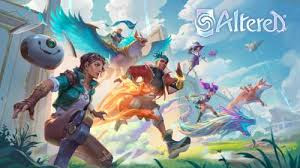
Cardboard Corner: Review of Altered TCG

Magic: The Gathering has been a smash hit. Inspiring dozens upon dozens of similar games, it brought about the Golden Age of expandable card games. But interest waned, the market moved in new directions, and the model faded. But it didn't disappear. A tiny number of such games stood strong while new ones appeared and disappeared like fireflies. It's now 2024 and a new wave of expandable card games is hitting the market. We're in the middle of a second Golden Age. Putting a horse in that race is Altered TCG (2024), which automatically generates questions. Does it have a unique edge to distinguish itself from the dozens and dozens of similar games releasing now? Does it have a chance at outlasting the Age—of being one of the few still standing once the sun has set on the second age? Let's check the horse's teeth.

I would (and will in a moment) argue that Altered has a truly unique edge. But at its absolute core, Altered does not upset the collectible card game apple cart. Two players bring pre-prepared decks comprised of units, spells, and permanents to battle it out in a head-to-head duel. These central concepts of CCGs remain the same. What lies beyond, however, is where things get special.

Saturday, July 20, 2024

Review of The Buried Dagger by James Swallow

It's taken fifty-four books, but we're here: the threshold of Terra. Horus' forces loom on the horizon as the universe focuses on the battle that is about to unfold. The last step to that edge is The Buried Dagger by James Swallow (2019).

The Buried Dagger is comprised of two primary storylines that oscillate as the book progresses. The first is centered on the Death Guard. In the opening pages, Mortarion ravages an Imperial planet but is pulled away from the action by one of his captains with direct orders from Horus himself: time to attack Terra. Slipping occasionally into Mortarion's childhood, this storyline forms the largest proportion of the book. In the second storyline, a secret operative traverses the labyrinths beneath Terra. He is approached by Malcador the Sigillite and given a special mission. Garro and the Grey Knights pulled into the action in the aftermath, Terra may fall before Horus arrives if they don't take care of business.

Friday, July 5, 2024

Review of Citizen in Space by Robert Sheckley

Robert Sheckley is one of the most exciting authors on my shelf. I never know what I'm going to get when cracking a book, only that it will be a smorgasbord of subtle wit, easter eggs, and imaginative storytelling. His 1955 collection Citizen in Space hasn't changed my mind despite the relative lack of substance.

The collection begins with “The Mountain Without a Name”. Something akin to Dubai in space, it tells of an Earth construction company terraforming a planet for human use, which includes converting their version of Mt. Everest into a sea. But bad luck seems to tail them, wrecking the crew's best made plans. Things eventually come to a head, and the men are left with the most dire (as intended) of choices. In “The Accountant”, Sheckley must have been having a bad day with bureaucracy. A throwaway story, it tells of parents pressuring their child to become a magician when all he wants is to be an accountant. Though structured like a bar joke, the punchline is more dark humor than knee-slapping.

Friday, June 28, 2024

Review of Stolen Faces by Michael Bishop

The perception of Aztec and Mayan cultures is often of a war-like, bloodthirsty people who made ritual sacrifice quotidian. While there is historical evidence in support of this image, it doesn't paint the full picture. Slaves and prisoners weren't the only people sacrificed. The belief was that blood offerings forestalled the end of the world, meaning many people voluntarily offered their lives—people who wanted their heart removed, body disfigured, and ultimately death in the name of the cause. Examining this phenomenon in a science fiction setting is Michael Bishop's superb Stolen Faces (1977).

Stolen Faces is the tragic story of Lucian Yeardance. After a personal conflict with a commanding officer, Yeardance is exiled to Tezactl and assigned the title of Commissar of the planet's leper colony. A difficult situation, Yeardance has only a small group of assistants to help manage the colony and supplies are limited, often not being delivered to their remote outpost on time. Exacerbating the situation is the fact the colony has devolved into near animalhood. The younger, healthier lepers torment and steal from the older, more debilitated ones, and a bizarre system of beliefs induce the people into sadomasochistic behavior. Getting to the bottom of the situation proves to be the opposite of what Yeardance expects.

Tuesday, June 25, 2024

Review of Black Helicopters by Caitlin R. Kiernan

I bounce off H.P. Lovecraft, hard. His prose is purple to the point of putridness and I condescend toward the paranoia and anxiety underlying the handful of stories I've read. Get a grip, dude. Reality is what it is, even if we can't explain everything. Secret evil is not waiting to pop out from behind every yard gnome you encounter (only a few). Caitlin R. Kiernan, however, I'm a sucker for. She often works in a similar medium (~existential horror), yet possesses some of the tip-top best prose out there, not to mention takes her reader's intelligence for granted. Black Helicopters (2013) is the perfect example of how deep (far?) cosmic “horror” can go.

Black Helicopters is a difficult story to encapsulate in just a couple of sentences. I will provide only the shell. Two rival agencies, operating invisibly yet in plain sight, have their sights set on one another. Butterfly effect in full effect, they tweak a social knob here, twist an event there, all in the hopes of manipulating the global dance in their subtle favor. At the beginning of the tale, one agent recruits two agents from the other side—knowing they are from the other side. And so too do the two other agents. Cat, mouse, and back again, they tango and samba around one another, getting at their secrets, bits of black magic and Weird just some of their tools of the job. Black helicopters—the proverbial variety—hover menacingly on the horizon.

Thursday, June 20, 2024

Review of The Tainted Cup by Robert Jackson Bennett

I dance in and out of Robert Jackson Bennett's works. I haven't danced out and stayed out because he is, relatively speaking, dynamic in creation. I cannot say he has a wide range of styles, but his stories are not all within one sub-genre and he tries to thread the needle of derivative enough to be familiar yet unique enough to distinguish itself. His latest book, The Tainted Cup (2024), may have just done that.

The Tainted Cup is an agent Mulder-and-Scully murder mystery in a fantasy land. Hill-sized leviathans seasonally come ashore, wrecking havoc on the cities and fields, and magical concoctions and brews allow people to augment themselves in various ways—strength, speed, analytical capability, and memory among them. Seven years ago a savage blight was accidentally unleashed upon the land, and it is still looking to recover.

Sunday, June 16, 2024

Review of Titandeath by Guy Haley

The end draweth nigh. Horus' rebellion approaches Terra. Standing in his path is an auxiliary outpost, the planet Geta-Garmon. Staging ground for Imperial operations, it is home to legios of Titans, the massive war engines. This last layer of the Emperor's protection faces the ultimate test of power in Titandeath by Guy Haley (2018).

Of the three dozen Horus Heresy books I've read, Titandeath is the one which feels most perfunctory. It fills a gap in the HH timeline: what have the Adeptus Mechanicus (light and dark) been doing since Graham McNeill's Mechanicus? It also answers the question: why did reduced numbers of titans take part in the Siege of Terra? The first question more interesting than the second, it remains, however, that Haley doesn't give the reader much reason to invest themselves in the story beyond that answer. The forces build up, a big battle occurs, and the book ends. While the same can be said of some HH books, it's with Titandeath the reader most strongly feels the sentiment: things happened as I expected.